
James Wilson is an Associate Professor in the Department of Earth, Atmosphere and Environment in the College of Liberal Arts and Sciences. Dr. Wilson taught an honors seminar in the spring 2026 semester titled, “The Making of Modern Science: Natural History, Philosophy, and Technology”
- Why were you attracted to offering an honors seminar?
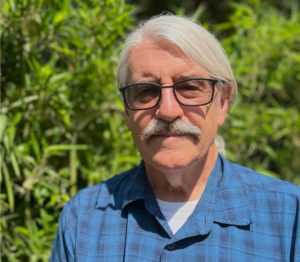
I was attracted to offering an honors seminar because it gave me the opportunity to share my interest in the history of natural history and science. For the last several years I have been teaching asynchronous online courses in the Department of Earth, Atmosphere and Environment, so it was nice to have the opportunity to step back into the classroom and try new things and experiment a little.
2. How do you teach your subject or specialty to an interdisciplinary group of Honors students?
I emphasize that everything is connected or related whether it be people, places, things, or events. This is very much a geographic perspective that can cover a diverse set of disciplines and topics that can mirror a wide variety of student interests. Ordinarily I teach different subjects in human geography that are part of my department’s GIS (Geographic Information Systems) curriculum. For the last several years I have been working with social network software that can be spatialized into a geographic representation. I am exploring networks as a way to trace the connections that can be found for any subject matter. With a little help from AI, network software can be used as a fun tool for a student to trace the development of technologies, innovations, and scientific knowledge in their area of interest.
3. What are some of your tricks of the trade to engage students in the course materials?
Most of us have access to easy and fast communication to anywhere in the world. However, prior to modern communication systems amateur and professional naturalists and scientists wrote letters, using pen and ink, that would take weeks and months for delivery. To appreciate this form of communication, we wrote letters using quills one evening in NIU’s Booklab with Drs Beth McGowan and Nicole Clifton. It’s not as easy as you might think! Throughout the course students have engaged with scientific ideas from Goethe and von Humboldt through various writing assignments. We also watch videos on historical science topics from lectures by authors to the restoration techniques of the remarkable glass models of sea creatures created by the Blaschka family. In the meantime, they are practicing creating their own networks on topics of their own choosing. In addition to science and technology, a student can also discover and study the science behind art including painting and music. The accumulation of these efforts leads up to a final presentation of what students learned about their history of science topic at the end of the course.
4. What’s the best thing about teaching Honors students?
In the age of STEM in education, I am trying to convey that science, even at the amateur level, can be accessed and practiced by anyone today as it was in the past. The best thing about teaching Honors students is their alacrity and positive spirit in undertaking class assignments and projects. I have been impressed by how many of them are such quick studies, which makes teaching even more fun!
