
My name is Angel, and I am a recovering overachieving-perfectionist.
I say that for two reasons; for one, I’m standing in a room full of Honors students, so I know I can’t be the only one who is used to striving for perfection.
The second reason is that I stand here before you with the assignment of explaining how the Honors Program impacted me. If I’m being completely honest, the most valuable thing I learned by being in this program was that I could still be successful without being perfect. But now I’ve skipped ahead to the end. Let me tell you a little bit about how I got here.

For any student, college is difficult. This is understandably expected, and it is by design. My education in Human Development and Family Sciences has taught me growth and change rarely ever occur without hardship, or at the very least, discomfort. I know I’m not unique in my experience of being challenged in my 3 years at NIU. Although I do believe the specific challenges I had may be different from the average student. Not only am I older than what is considered “college age,” but I am also a mother to two extremely energetic toddler boys. They keep me so busy. However, with support from the Honors Program, I turned these challenges into success.
When I transferred into NIU, I already possessed an intuitive understanding of my own strengths and weaknesses. I knew I could write well; I enjoyed reading, and I have always been interested in consuming all the information I possibly could. Ultimately, I knew I would be able to do well in my courses. However, I also knew that with daily familial responsibilities and living off-campus, my schedule would not allow for extensive participation in extracurricular activities. I honestly do not have the time.
In assessing my strengths and weaknesses, I joined the Honors Program because I felt that would be my only shot at having some form of belonging on campus. Also, my future graduate school plans require me to set myself apart from other candidates. I felt certain about the benefits of joining the Honors Program—thinking it was exactly what I needed to achieve that perfect student status I craved. I had no idea this program would actually teach me a different, more valuable, lesson about myself.
In my honors seminar, my professor modeled genuine compassion and care for me when I couldn’t be “perfect”. On several occasions, I was forced to ask for assignment extensions because my children came first, my homework came second, and this was the only way I could prioritize my life. Each time, my professor supported me, and I passed that seminar. My grade wasn’t perfect, but it was good, and that professor even offered to write my letter of recommendation for grad school.

In the honors sections of other courses, it was expected of me to meet higher standards, while also assuming a leadership role as an example to others. Sometimes, for me, that leadership looked like voicing concerns for certain assignments, or asking A LOT of questions. I learned it was okay to admit that I was confused or overwhelmed at times.
I loved how the other Honors students modeled great professionalism, and dedication, showing me that it was okay to be a little competitive because taking our studies seriously is something to be proud of.
When I really started to struggle, the Honors advisors were empathetic in reminding me I cannot always be perfect, so they were there to help. One semester, I had a tragic incident that destroyed my laptop finals week. In addition to some other tough things I was dealing with in personal life, my laptop was broken, and so was my spirit. I had my two little boys with me, so I couldn’t go to a computer lab, and I missed turning in a whole final project. So, my GPA dropped, and I was put on academic probation in the program.
I had multiple meetings with multiple advisors, and all of them offered the resources I needed to get back on track. That semester I learned that this is what the Honors Program is about. It’s not about being perfect; it’s not about being at a higher level than the rest of the student body. It’s about support; it’s about support for those of us who just want to do a little bit more, those of us who truly enjoy going above and beyond—when we can.
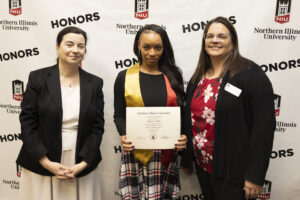
Being a part of the Honors Program has been much more than solely an accolade, or acknowledgment, of my degree. At a time when coming back to school in my thirties initially made me feel inferior, and like I had to do everything perfectly to prove myself, my Honors status placed me in a position of empowerment knowing that just being good enough is still worthy of honor.
This paradox occurred because I joined the Honors Program to look perfect on paper, yet being in the Honors Program helped teach me that being perfect isn’t important—and it’s just not always possible. I learned that after giving my all, putting in my best efforts, sometimes I would fall short of what I considered perfection—and that’s okay because my achievements are still honorable. I did it; WE DID IT. In one week, we will officially be Huskie alumni forever. Congratulations.
